Why AI Coding Tools Are Broken for Real Engineering
AI generates brilliant React components and catastrophic C++ bugs with the same confidence. The fix isn't smarter AI — it's a language designed for the AI era.
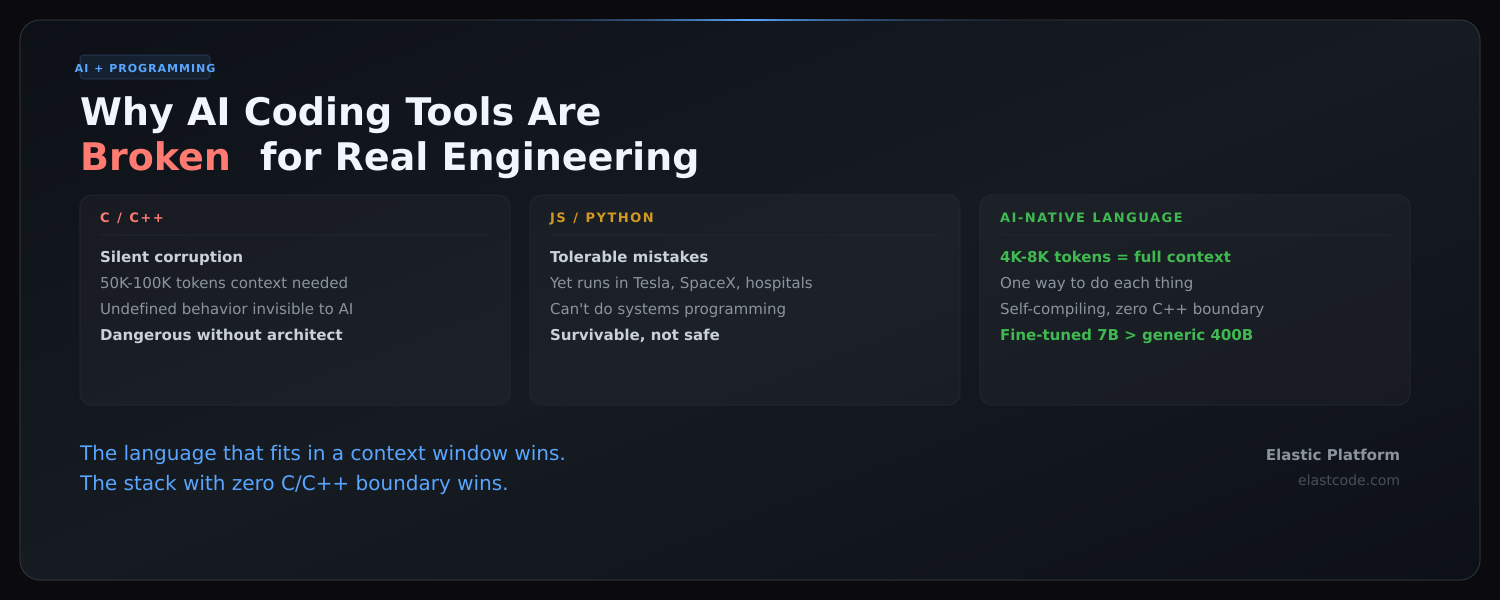
AI can write a React component in 10 seconds. AI can also introduce a memory corruption bug in C++ that won't crash for 3 weeks, then destroys production data on a Tuesday night. Same AI. Same confidence level. Very different outcomes.
I've spent 2 years working with AI on a systems-level C++ codebase — JIT compiler, custom database engine, network protocols, real-time scheduling. Here's what I've learned about why AI coding tools fail at real engineering, and what actually fixes it.
"AI is for web languages, that's fine" — Really?
Some engineers will tell you: "AI was built for modern web languages — JavaScript, Python, TypeScript. That's where it shines. That's fine."
Okay. Let's follow that logic. If AI works great for JS/Python, we should use those languages everywhere, right?
And if you look around — that's exactly what's happening:
- Tesla's car infotainment runs on Qt/JavaScript
- SpaceX Dragon crew capsule flight UI runs on Chromium + JavaScript
- Banks worldwide run transaction dashboards on Node.js and React
- Medical devices increasingly use Python and Electron for patient monitoring UIs
- Slack, VS Code, Discord — used by hundreds of millions — are Electron (JavaScript) apps
- Government portals handling citizen services run on JS/Python
"Web languages" are no longer just for the web. They're in your car, your hospital, your spacecraft.
But AI makes mistakes there too
Ask any senior JS developer. AI-generated JavaScript has:
- Security vulnerabilities — XSS, injection, auth bypasses
- Memory leaks in Node.js that crash production after 72 hours
- Race conditions in async code that appear once per 10,000 requests
- Wrong business logic that passes all tests — because AI wrote the tests too
The bugs are just less catastrophic than C++. A JS memory leak restarts a process. A C++ memory corruption corrupts a database. "Less catastrophic" isn't "safe." It's just "survivable."
The real picture
| Language | AI mistake severity | Systems capability | AI context needed |
|---|---|---|---|
| C/C++ | Dangerous — silent corruption | Full systems access | 50K-100K tokens |
| JS/Python | Tolerable — runtime exceptions | No systems programming | 10K-30K tokens |
| Rust | Borrow checker blocks bad code | Full systems access | 15K-40K tokens |
| AI-native platform | Loud errors, no UB | Full stack coverage | 4K-8K tokens |
No existing language is designed for the reality we live in: a world where AI writes most of the code.
What AI actually sees vs. what an architect sees
When AI reads a C++ function, it sees: a function signature, some local variables, a pointer being dereferenced. Code that compiles.
When a systems architect reads the same function, they see: who owns this memory? What thread could be accessing it concurrently? What happens when this pointer outlives the object it points to? How does this interact with the allocator three layers down?
AI generates code that compiles. An architect generates code that survives.
My conclusion after 2 years: AI without an architect is dangerous in systems code. AI with an architect is 10x productive. The architect's job isn't writing code anymore. It's constraining the decision space so the AI can't make catastrophic mistakes.
But this isn't a C/C++ problem exclusively. It's an architecture problem. AI is bad at architecture, and C/C++ punishes architectural mistakes with silent corruption instead of loud errors.
The slop problem
Beyond correctness, there's a second issue: AI slop.
You know it when you see it: "It's important to note that..." "Let's dive into..." "Great question!" Words that say nothing.
In code, slop looks like: unnecessary abstractions, over-engineered error handling for impossible cases, comments explaining what the code obviously does, "just in case" features nobody asked for.
Why does slop exist? AI models are trained on internet text. Internet text rewards politeness, hedging, and verbosity. Humans upvote responses that seem thorough. So the model learned: more words = more approval. Slop is the model optimizing for seeming helpful rather than being helpful.
Two ways to fix slop — one is permanent
Method 1: Prompting (instructions, system prompts, rules). Result: ~95% reduction. The slop patterns still exist in the model's weights, but instructions suppress them. Under pressure — long context, novel situations — the remaining 5% leaks through.
Method 2: Fine-tuning (training on your own data). Result: 100% elimination. You're not suppressing slop — you're replacing the output patterns entirely. The model doesn't fight against its training because its training is your style.
Prompting is makeup. Fine-tuning is surgery.
We've tested both approaches extensively. Fine-tuned models on our own codebase produce zero slop — not because they're smarter, but because their training data doesn't contain it.
The language problem
If fine-tuning eliminates slop, and an architect eliminates dangerous architectural mistakes — what's left? The language itself.
C++ has massive semantic surface area. Templates, preprocessor macros, five initialization syntaxes, three smart pointer types, decades of accumulated idioms. Even a fine-tuned model drowns in the ambiguity.
What if the language were designed for the AI era?
- One way to define a class. Not five.
- One include mechanism. Not preprocessor + modules + import.
- Built-in database operations. No ORM, no SQL strings, no driver configuration.
- Built-in networking with encryption. No library selection, no dependency hell.
- Files are 200-2,000 lines, not 10,000. The whole context fits in one model call.
A fine-tuned model on this language wouldn't need to be GPT-4 smart. A 7B parameter model that knows one language perfectly would outperform a 400B model that knows everything approximately.
Context window economics
| Metric | C++ project | JS / Python | Self-contained platform |
|---|---|---|---|
| Tokens to understand 1 module | 50K–100K | 10K–30K | 4K–8K |
| AI visibility into dependencies | ~10% | ~40% | 100% |
| Build system complexity | CMake/Make/Ninja + flags | package.json / pip | One config file |
| Cross-language boundaries | C++ / ASM / linker | C extensions, native | Zero |
| Consequence of AI mistake | Silent corruption | Runtime exception | Compile error |
| Fine-tuning corpus size | Millions of lines | Millions (+ npm/pip) | ~500K lines total |
Context window isn't about size. It's about signal-to-noise ratio.
The self-compilation advantage
Python's interpreter is C. Node's V8 engine is C++. Java's JVM is C++. Ruby, PHP, R — all C underneath.
Every language inherits C/C++'s problems at the foundation. Bugs in the runtime are C++ bugs. AI can't fix them without C++ expertise.
A language that compiles itself removes this boundary. The entire stack — compiler, runtime, database, applications — is one language. One mental model. One set of rules for AI to learn.
A fine-tuned 7B model on that stack would outperform a 400B model that knows everything approximately. Not because it's smarter — because it doesn't need to be.
The paradigm shift
Old thinking: "Make AI smarter so it can handle C++."
New thinking: Make the language simpler so AI doesn't need to be genius-level.
Old thinking: "Prompt engineering will fix AI output quality."
New thinking: Fine-tuning on a clean, self-consistent codebase eliminates the problem at root.
Old thinking: "Web languages for web, systems languages for systems."
New thinking: One platform that does both — designed for the world where AI writes the code.
Old thinking: "One massive model for everything."
New thinking: One focused model that masters one complete platform.
Conclusion
The teams building new programming platforms from scratch today aren't competing with C++. They aren't competing with JavaScript either. They're building for a world where AI writes 80% of the code and humans architect the remaining 20%.
In that world, the language that fits in a context window wins. The platform with the smallest bug surface wins. The stack with zero C/C++ boundary wins.
This is the reason why I created the Elastic Platform.
Michael Korneev is the founder of Elastcode and creator of the EPL programming language — a self-compiling platform with built-in database, networking, and GUI framework. Follow on X @elastcode.